
Vibe Coding for Engineers
Post description

Date
September 06, 2026Updated
September 12, 2026Category
BlogMinutes to read
5 minThe Engineering Guide to Vibe Coding in Python: From Intuition to Production
The phrase "vibe coding" began as a meme—a description of developers letting AI write all the boilerplate while they just "vibed" with the architecture. But for working engineers in 2026, vibe coding cannot mean reckless coding.
True engineering isn't about abandoning rigor; it’s about accelerating feedback loops. When you combine modern Large Language Models (LLMs), grounded real-time search, disciplined environment isolation, and strict automated verification, vibe coding shifts from a novelty into one of the highest-leverage paradigms in modern software development.
Here is an end-to-end engineering guide to vibe coding in Python.
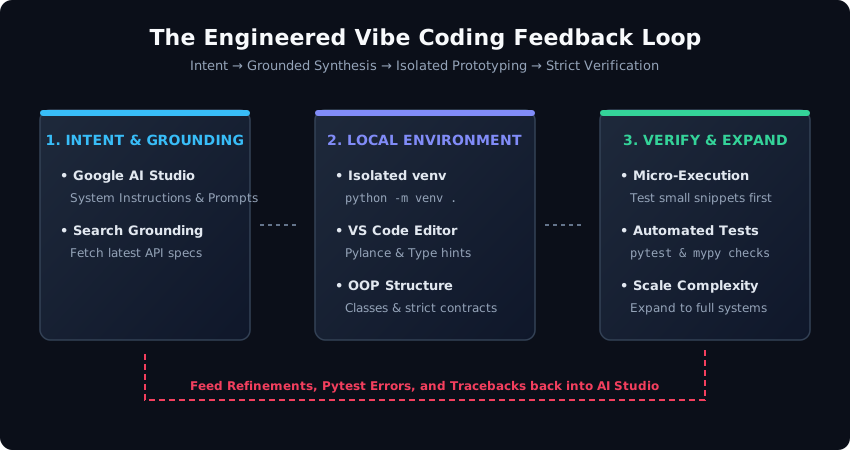
1. What is "Vibe Coding"?
Vibe coding is a workflow where developers interact with an LLM primarily through natural language and intent, delegating the mechanical typing of syntax to the AI.
The Amateur Approach: Prompting blindly, refusing to read the generated code, and deploying hallucinations that eventually crash.
The Engineering Approach: Elevating yourself from a junior coder to a System Architect/Tech Lead. You design the data structures, interfaces, and testing boundaries. The LLM acts as an eager, hyper-fast junior developer writing the implementation.
2. Python Environment Setup & OOP Foundations
Vibe coding generates code fast. If you don't contain it in an isolated environment with strict Object-Oriented guidelines, your project will turn into a tangled mess of spaghetti scripts.
2.1 Python Installation & VS Code Setup
Install Python: Ensure you are running a modern version (Python 3.12+).
Install VS Code: Download Visual Studio Code.
Extensions: Install the Python extension (by Microsoft) and Pylance (for deep type checking).
2.2 Virtual Environments
A Python virtual environment is like a separate sandbox for each project that keeps its specific tools completely isolated, preventing messy version conflicts and keeping your computer's main system safe. Never install generated package requirements globally. Keep them scoped to your project.
Navigate to your project folder in your terminal and run:
code Bash
python -m venv .(This creates the virtual environment files directly in your current directory. Alternatively, use python -m venv .venv to hide them in a subfolder).
Activate it:
macOS / Linux: source bin/activate
Windows: .\Scripts\activate
Select this interpreter in VS Code (Ctrl/Cmd + Shift + P -> Python: Select Interpreter).
2.3 Object-Oriented Programming (OOP) for AI
In mechanical engineering, you wouldn't design a new car from scratch; you’d take an existing chassis design and modify it. OOP lets you do the same thing. You can create a base blueprint (e.g., a "Vehicle" class with wheels and an engine) and then create specialized versions (like a "Truck" or "Sports Car") that automatically inherit the base features. You only write the new code for what makes the truck different. OOP allows you to build software the same way you build a machine—by designing modular, reusable, and standardized components. This makes it much easier to troubleshoot, upgrade, and scale a complex system without everything breaking.
LLMs thrive on constraints. Providing an Object-Oriented skeleton ensures the AI writes predictable code.
code Python
from dataclasses import dataclass
from abc import ABC, abstractmethod

@dataclass
class TelemetryData:
    """Immutable data container for strict typing."""
    device_id: str
    temperature: float

class TelemetryProcessor(ABC):
    """Abstract contract that the AI must follow."""
    @abstractmethod
    def process(self, data: TelemetryData) -> bool:
        pass
When you prompt the AI, you say: "Implement a ThermalProcessor class that inherits from TelemetryProcessor." This locks the AI into your architecture.
3. Google AI Studio Playground & Grounding with Google Search
When you ask an AI to write code using fast-moving libraries (like Pydantic, LangChain, or pandas), base models often hallucinate deprecated parameters.
Google AI Studio solves this.
Go to Google AI Studio.
In the right-hand Tools menu, toggle on Grounding with Google Search.
Why this is a game-changer:
If you prompt, "Write an async script using the latest 2026 syntax of DuckDB," the model will query the live web, read the latest API documentation, and synthesize accurate, up-to-date code. Grounding turns a static LLM into a dynamic research assistant.
4. Prompt Engineering for Engineers
Engineers do not write: "Write a script to parse logs."
Engineers write specifications.
Use the R-C-C-O Framework for bulletproof vibe coding:
Role: Who is the model? (e.g., "You are a Principal Backend Python Engineer.")
Context: What is the task? (e.g., "We are parsing high-throughput JSON logs.")
Constraints: What are the strict rules? (e.g., "Use Python 3.12+, strictly use pydantic, no synchronous I/O, enforce PEP 484 type hints.")
Output Format: What exactly do you want back? (e.g., "Output only the complete Python class and a separate pytest suite.")
5. Step-by-Step Approach: Small Verification to Complex Expansion
The biggest mistake developers make is asking for a 500-line monolithic application in a single prompt. When it fails, debugging is impossible. Instead, use Test-Assisted Incremental Iteration:
The Micro-Spike: Ask the AI for a single function to prove the core logic.
(Prompt: "Write a standalone function to flatten a nested JSON payload.")Execute & Verify: Run this 10-line script locally. Ensure it works.
Encapsulate (OOP): Ask the AI to refactor the working function into a Class with proper type hints and error handling.
Scale Complexity: Finally, ask the AI to wrap that Class in an asynchronous queue or API endpoint.
Because you verified the core logic in Step 1, if Step 4 breaks, you instantly know the issue is in the orchestration layer, not the parser.
6. Verification of the Results
In vibe coding, trust nothing; verify everything. The LLM output must pass through automated gates before you accept it.
1. Pytest
Always demand tests in your prompt.
code Bash
pip install pytest
pytest test_processor.py -v
2. Static Typing (mypy) and Linting (ruff)
Enforce strict typing to catch AI hallucinations where variables magically change types.
code Bash
pip install mypy ruff
ruff check .
mypy processor.py
3. The Feedback Loop
If mypy or pytest throws an error, do not manually fix it.
Copy the exact traceback from your terminal, paste it back into Google AI Studio, and say:
"The code threw this error during mypy validation: [paste error]. Fix the implementation to resolve this type conflict safely."
The compiler becomes your automated LLM evaluator.
7. Summary
Vibe coding doesn't replace software engineering—it elevates it.
PhaseEngineering DisciplineWorkspaceIsolate everything using python -m venv . and VS Code + Pylance.ModelUse Google AI Studio with Search Grounding to ensure up-to-date syntax.ArchitectureAnchor generations using OOP contracts, dataclasses, and abc interfaces.PromptingUse R-C-C-O (Role, Context, Constraints, Output) specifications.DevelopmentBuild iteratively: micro-spike → verify → object-orient → scale.VerificationEnforce zero-trust. Run pytest, ruff, and mypy. Feed terminal tracebacks back to the AI.
By mastering this cycle, you stop wrestling with mundane syntax and start designing resilient systems at an unprecedented speed.