Fear & Greed Index at 9.7: What Would Warren Buffett Buy Now?
Between Jensen Huang’s shock exit, a historic U.S.–China–Russia summit, and Fed rate jitters, Wall Street’s mood meter has hit 9.7. In noisy weeks like this, the investors who step back, stick to a plan, and buy great assets in small, steady steps are usually the ones smiling a year later.

Date
November 21, 2026Updated
November 21, 2026Category
BlogWord count
1.3k wordsViews
1Jensen Huang’s Shock Exit, a U.S.–China–Russia "Big Bosses" Summit, and Fear at 9.7: What Would Warren Buffett Buy Now?
Investing legend Warren Buffett gave the world its most famous piece of financial wisdom:
"Be fearful when others are greedy, and greedy when others are fearful."
It sounds effortless when you read it on a motivational poster. It feels completely different when your brokerage app is glowing bright red and you catch yourself muttering, "Sure, Warren—easy for a billionaire to say!"
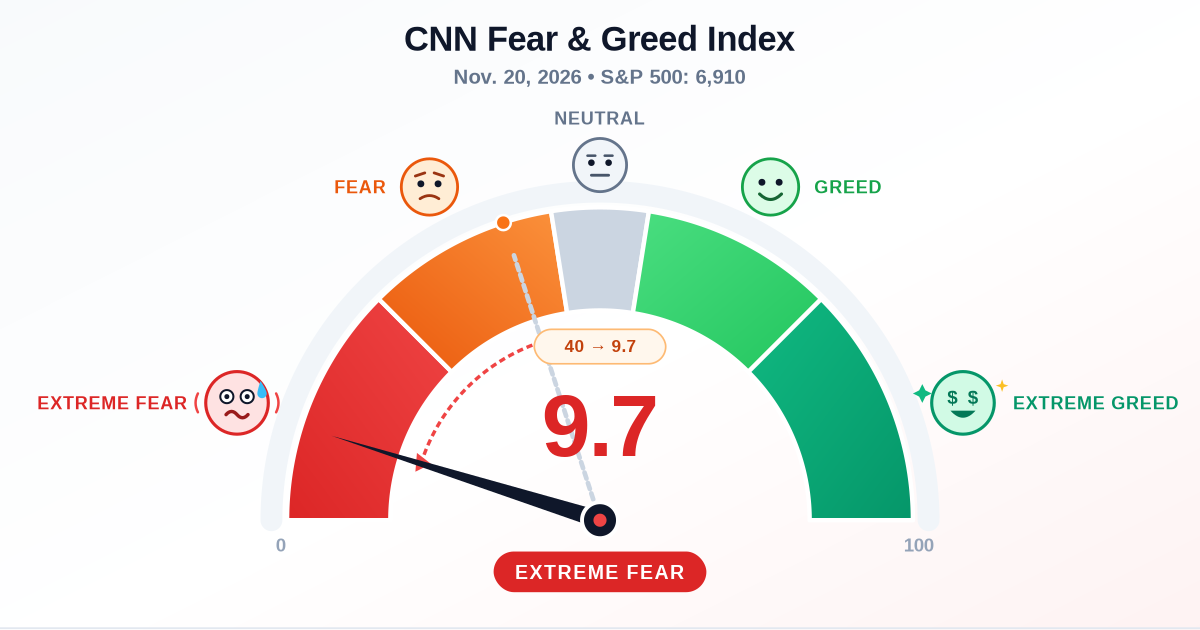
That is exactly where the market sits as of November 20, 2026. With the S&P 500 sliding to 6,910.39, Wall Street’s famous mood gauge—the CNN Fear & Greed Index—just plunged over 30 points in six trading days to hit 9.7 (rounded to 10). Market sentiment hasn't just cooled off; it has frozen solid.
Between CEO scandals, historic superpower summits, and rate-hike jitters, last week felt like a season finale. Here is a plain-English, beginner-friendly breakdown of what the Fear & Greed Index actually measures, when it nails market bottoms, four traps where it fails, and what everyday investors should do next.
1. What Is the CNN Fear & Greed Index? (Think of It as Wall Street’s Mood Ring)
Created by CNN Business, this index tells you whether Wall Street traders are currently terrified or euphoric on a simple 0 to 100 scale:
0–24 (Extreme Fear 😱): "Everything is breaking—sell it all!" (At
9.7, we are deep in this red zone.)25–44 (Fear 😰): "Something feels off. I’m nervous."
45–55 (Neutral 😐): "Just another normal day."
56–74 (Greed 😊): "Things are rolling—maybe I should buy more."
75–100 (Extreme Greed 🤩): "If you aren’t all-in right now, you’re missing out!"
Here is why investors watch it closely: CNN doesn’t send out an opinion survey. Instead, it tracks seven real-money behaviors behind the scenes—like how far prices have stretched from their trend, whether traders are betting on crashes in the options market, how jumpy volatility (VIX) is, and whether people are fleeing stocks for safe government bonds. It ignores what Wall Street says and watches what Wall Street does with its cash.
2. History Check: Does "Extreme Fear" Really Mean Stocks Are on Sale?
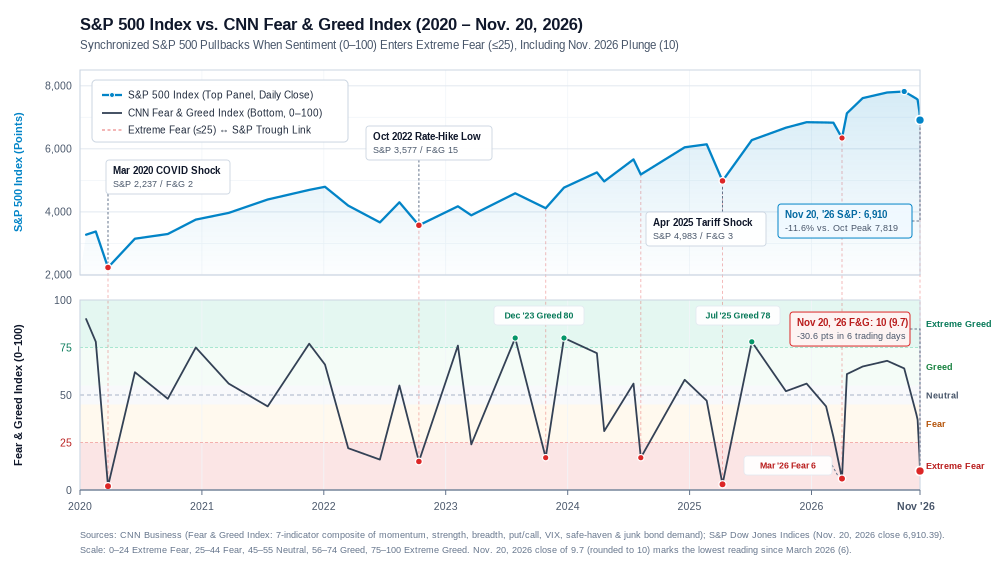
Looking back over the past six years, Extreme Fear readings have lined up with major S&P 500 turning points with uncanny accuracy:
March 2020 (COVID Crash): Dropped to
2→ Marked the bottom right before a massive rally.October 2022 (Rate-Hike Bear Market): Hit
15→ Coincided with the 2022 bear-market low.April 2025 (Tariff Shock): S&P 500 dropped 19% and the index hit
3→ Nailed the exact bottom before a summer rebound.March 30, 2026: Plunged to
6→ Stocks went on to hit an all-time high of7,819in October.
In fact, since 2021, whenever the Fear & Greed Index dropped below 10, the S&P 500 bounced back by an average of +9% to +10.5% over the next three weeks. Think of a department store clearance rack: once everyone who wanted to panic-sell has already hit the sell button, it only takes a tiny spark of good news for prices to rebound.
3. Hold On—4 Times This Mood Meter Gets It Wrong
Before you treat a 10 reading as an excuse to throw every penny into the market tomorrow morning, know the four traps that catch beginners off guard:
It’s terrible at telling you when to sell (2023–2024):The gauge is much better at spotting panic than calling tops. During strong bull markets like late 2023 and 2024, the index stayed in "Greed" and "Extreme Greed" (
75–80+) for months while stocks kept climbing. People who sold early on greed signals missed huge gains.Sometimes there’s a basement beneath the basement (2022):In 2022, Fear & Greed fell into the teens in both March and June—yet the S&P 500 still fell lower into October because the Federal Reserve wasn’t done raising rates. Buying blindly during a macro downtrend can mean catching a falling knife.
The warning siren never rang in 2026:Even as the S&P 500 climbed to
7,819in early October 2026, the Fear & Greed Index never once reached Extreme Greed (75+)—it peaked at71. Anyone waiting for a75+sell alert never got one before November’s slide.It’s a rearview mirror, not a crystal ball:Because it calculates scores from prices that already happened, it cannot warn you ahead of time about tomorrow’s surprise headline.
4. The November 2026 Soap Opera: What Just Shook the Market?
Last week wasn't an ordinary pullback—three massive plot twists hit the tape at the exact same time:
① AI’s Biggest Rockstar Stepped Down — And Nvidia Tumbled
On November 12, Nvidia’s iconic leather-jacket CEO Jensen Huang abruptly resigned amid a personal and China-linked tech scandal. Then on November 20 alone, Nvidia (NVDA) plunged 14% to $125.53 amid SEC accounting probe headlines—now down roughly 45% from its October peak ($243.37), wiping out over $2.7 trillion in market value. (Elon Musk even publicly floated recruiting Jensen to lead SpaceX’s Terafab chip project!) Because Nvidia carried massive weight inside the S&P 500, its slide sparked fresh anxiety over whether trillion-dollar AI spending will pay off anytime soon.
② The "Big Bosses" Table in Shenzhen (U.S.–China–Russia Summit)
On November 19, in an unprecedented moment, Donald Trump, Xi Jinping, and Vladimir Putin sat down together around one giant circular table in Shenzhen, China, for a historic three-way summit. The three superpower heavyweights issued a joint pledge to avoid nuclear conflict and increase global refined oil and fuel supplies. Softer oil prices are actually great news for cooling inflation—yet watching the world’s three biggest powers redraw trade and geopolitical lines kept investors on edge.
③ The Fed’s December Brake Pedal + Margin-Call Dominoes
Meanwhile, markets under Fed Chair Kevin Warsh are bracing for another 0.25% interest rate hike at the December 8–9 Fed meeting. Add in leveraged traders forced to dump stocks, gold, and Bitcoin to cover margin calls, and panic snowballed fast—pushing CNN’s Fear & Greed Index straight down to 9.7.
5. What Comes Next? + 3 Buffett-Style Moves for Everyday Investors
So where does the market go from here?
Short Term (December 2026): Expect choppy waves at least until the Fed’s December 8–9 decision clears the air. That said, oil easing back down after the Shenzhen summit is a welcome relief for future inflation.
Bigger Picture (2027 Outlook): Even after November’s shakeout, major Wall Street banks still project the S&P 500 reaching
8,000–8,700by the end of 2027. While Jensen Huang’s exit rattled Nvidia, global demand for AI infrastructure hasn’t vanished—though going forward, companies with real profits will matter far more than hype.
💡 3 Simple Rules to Apply Buffett’s Wisdom Without Stress
Treat
<10as "Start Shopping Slowly," Not "Go All-In"Today’s9.7could still dip to5next week. Split the cash you want to invest into 3 or 4 pieces—buy a little during Extreme Fear, keep dry powder ready in case prices drop more, and invest the rest once the dust settles.Never Touch Your Cash CushionBuffett’s real secret weapon during crashes isn’t predicting the future—it’s holding plenty of cash. Keep your emergency fund separate so you stay calm and buy bargains instead of panicking.
Skip Single-CEO Drama—Own the S&P 500 InsteadIf watching a single headline send a giant stock down 14% in a day gives you heartburn, let a simple S&P 500 index ETF do the heavy lifting. Owning 500 top U.S. businesses at once ensures that even when one star stumbles, your long-term wealth rides with the whole team.
The Bottom Line:
Between Jensen Huang’s shock exit, a historic U.S.–China–Russia summit, and Fed rate jitters, Wall Street’s mood meter has hit9.7. In noisy weeks like this, the investors who step back, stick to a plan, and buy great assets in small, steady steps are usually the ones smiling a year later.