Solar System
Post description

Date
October 13, 2026Updated
October 16, 2026Category
UIMinutes to read
5 minThe Mathematical and Physical Theory of Planetary Position Calculation
Calculating the coordinates of a planet in the solar system at any given moment in time is one of the classic problems of celestial mechanics. It bridges Newtonian gravity, Keplerian orbital geometry, and numerical mathematics.
1. Fundamental Principles: Kepler's Laws
Planetary orbits are governed by the gravitational pull of the Sun. In an idealized two-body system (one planet orbiting the Sun), the motion follows Kepler’s Three Laws:
First Law (Elliptical Orbits): The orbit of a planet is an ellipse, with the Sun situated at one of the two focal points (foci).
Second Law (Equal Areas): A line segment joining a planet and the Sun sweeps out equal areas during equal intervals of time. (A planet moves faster at perihelion and slower at aphelion).
Third Law (Harmonic Law): The square of the orbital period () is directly proportional to the cube of the semi-major axis () of its orbit:
2. The Reference Framework
To map positions in 3D space, astronomers use the Heliocentric Ecliptic Coordinate System:
Origin : The center of the Sun.
Reference Plane (Ecliptic): The plane of Earth's orbit around the Sun.
Principal Direction ( axis): The Vernal Equinox ()—the direction of the Sun as seen from Earth on the first day of spring (intersection of the celestial equator and ecliptic).
Z-Axis (): Perpendicular to the ecliptic plane, pointing north.
Reference Epoch: Because coordinate planes drift over millennia due to precession, orbital elements are anchored to a fixed epoch, typically J2000.0 (January 1, 2000, at 12:00 UT).
3. The Six Keplerian Orbital Elements
An unperturbed orbit is uniquely defined by six geometric constants:
Symbol | Name | Description |
|---|---|---|
Semi-Major Axis | The size of the orbit (half the longest diameter of the ellipse), measured in Astronomical Units (AU). | |
Eccentricity | The shape of the ellipse ( is a circle; is an ellipse). | |
Inclination | The tilt of the orbital plane relative to the ecliptic plane. | |
Longitude of Ascending Node | The horizontal angle where the planet crosses the ecliptic from south to north. | |
or | Longitude of Perihelion | The angle from the equinox to the point of closest approach to the Sun (, where is the argument of perihelion). |
or | Mean Longitude at Epoch | The angular position of the planet along its orbit at reference epoch . |
4. Step-by-Step Calculation Procedure
Given a calendar date (), the mathematical pipeline to compute coordinates follows five distinct steps.
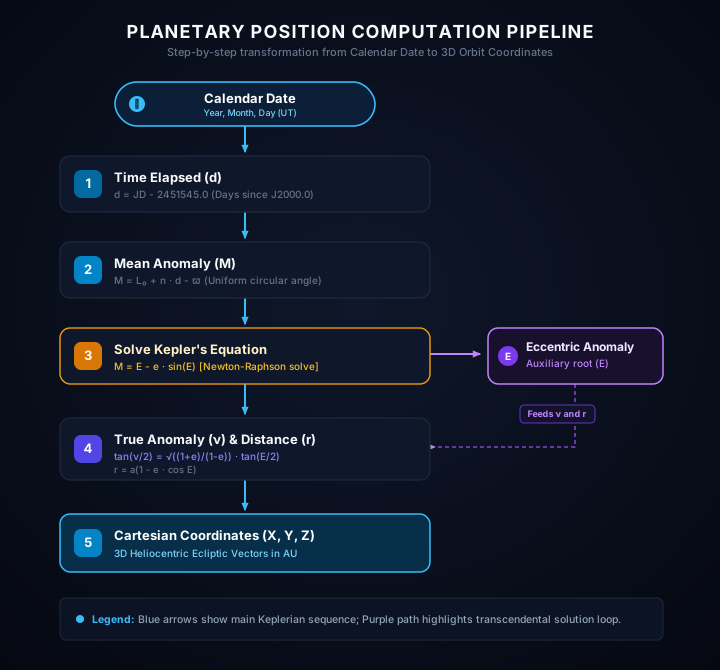
Step 1: Calculate Elapsed Time ()
Compute the number of days elapsed since the reference epoch J2000.0:
(where is the Julian Date of the target timestamp).
Step 2: Calculate the Mean Anomaly ()
The planet's Mean Daily Motion () represents its average angular velocity in degrees per day:
Because elliptical motion is non-uniform, astronomers define a fictitious body moving at a constant speed:
Mean Longitude ():
Mean Anomaly (): The angular distance from perihelion that the planet would have covered if its orbit were circular:
Step 3: Solve Kepler's Equation for Eccentric Anomaly ()
To convert uniform circular motion () into true elliptical motion, Kepler introduced the auxiliary geometric angle called the Eccentric Anomaly ():
(with and expressed in radians).
Why this step is difficult:
This is a transcendental equation—it is mathematically impossible to solve for using elementary algebraic operations. It must be solved using one of two approaches:
Method A: Newton-Raphson Iteration (Exact / Numerical)
We find the root of :
Starting with initial guess , this converges within 3 to 5 iterations for planetary eccentricities.
Method B: Equation of Center Approximation (Analytical)
For small eccentricities (), such as most major planets, the True Anomaly () can be calculated directly by series expansion without iteratively solving for :
Step 4: Calculate True Anomaly () and Distance ()
If the Eccentric Anomaly () was determined via Newton's method:
The True Anomaly () (the actual angular position measured from perihelion) is obtained via:
The Distance from Sun () in AU is:
Step 5: Convert to 3D Cartesian Coordinates
A. Coordinates in the Orbital Plane
In the 2D plane of the orbit itself (where points toward perihelion):
B. Rotation to Heliocentric Ecliptic Coordinates
To translate the orbit into the ecliptic coordinate frame, apply three successive Euler rotations:
Rotate by argument of perihelion in the orbital plane.
Rotate by inclination around the node axis.
Rotate by longitude of ascending node in the ecliptic plane.
The combined transformation yields:
5. Simplified 2D Coplanar Model
Because the planets in our solar system orbit nearly in the same plane (Mercury has the highest inclination at ; Earth is ; others are ), educational models often project coordinates into a 2D planar approximation ():
This yields high visual fidelity for charts, dashboards, and spreadsheets while reducing mathematical complexity.
6. Real-World Perturbations and Ephemerides
Keplerian orbits are idealized two-body approximations. In reality, multiple complex forces perturb these paths:
N-Body Perturbations: Planets exert gravitational pull on one another. Jupiter and Saturn, possessing over of non-solar planetary mass, significantly disturb the orbits of other bodies.
Relativistic Precession: General relativity introduces an additional advance of perihelion (e.g., per century for Mercury) unexplained by Newtonian mechanics.
Secular Variations: Orbital elements themselves drift over centuries. Modern formulas represent elements as polynomials of time:
Modern Ephemeris Standards
For space navigation and astronomical observatories, Keplerian elements are replaced by:
VSOP87 / VSOP2013 (Variations Séculaires des Orbites Planétaires): Semi-analytical expansions containing thousands of periodic trigonometric terms.
JPL Development Ephemeris (DE440/DE441): Direct numerical integrations of the relativistic equations of motion matching spacecraft telemetry and laser ranging.