I Built a Tool to Calculate the Exact Day Work Becomes Optional
I built the FIRE Toolkit—a complete financial independence calculator that models your entire wealth journey: 🎯 Calculates your Lean, Regular, and Fat FIRE targets ⏳ Uses exact math to find your freedom date 🌴 Simulates the "Decumulation Phase" 📊 Auto-plots your Age vs. Ending Balance curve

Date
September 30, 2026Updated
November 01, 2026Category
UIWord count
1.3k wordsViews
19
A Small Tool to Calculate the Day I Can Finally Slow Down
Let’s be honest: at some point this week—likely around 2:14 PM on a Tuesday during a routine video call that probably could have been a three-sentence email—you glanced out the window and wondered:
"What if I could simply choose when to step away?"
Not in a dramatic, burn-your-bridges kind of way. Just a quiet, intentional transition into a slower rhythm: baking sourdough, sleeping past 7:00 AM without an alarm, and having the freedom to never open another slide deck unless you genuinely want to.
Online, people call this FIRE (Financial Independence, Retire Early).
I like to think of it as Financial Independence, Recreational Eating.
To figure out whether my personal finish line was "six years from now" or "well after my 90th birthday," I did what any spreadsheet enthusiast with a dream would do: I built a dynamic, honest financial modeling toolkit.
Here is how the framework works, how it fundamentally shifted the way I view my paycheck, and why testing your own numbers might give you some well-earned peace of mind.
Step 1: Taking an Honest Look at Annual Expenses
A lot of traditional retirement calculators tend to feel discouraging. You plug in your current age, and they immediately spit out a staggering, arbitrary verdict:
"To retire comfortably, you will need $4.8 million in liquid cash. Best of luck!"
A practical tool shouldn't overwhelm you with impossible figures. Instead, it should start from a well-researched, foundational benchmark: The 4% Rule (derived from the widely studied Trinity Study).
Here is the perspective shift: Your target number isn’t determined by your gross salary—it’s determined by your actual cost of living.
The baseline formula is wonderfully straightforward:
Target Portfolio = Annual Expenses × 25 If you live comfortably on 50,000 a year ,your target invested portfolio is 1.25 million. Once invested in diversified index funds, you can systematically withdraw 4% each year to cover groceries, hobbies, housing, and life’s little joys, allowing your principal balance to weather market cycles over the long haul.
Step 2: Choose Your Path (The Four Flavors of Freedom)
Because freedom looks different for everyone, a good model shouldn't force you into a one-size-fits-all box. The toolkit breaks down four distinct approaches:
Lean FIRE (The Intentional Minimalist):
Targeted at ~75% of your current spending. This is for the minimalist who finds joy in simplicity—cooking at home, riding a bike, keeping subscriptions light, and trading material upgrades for complete autonomy over their daily schedule.Regular FIRE (The Balanced Baseline):
Targeted at 100% of your current budget. You maintain the lifestyle you already enjoy: buying good groceries, traveling once or twice a year, and living comfortably without making drastic lifestyle sacrifices.Fat FIRE (The High-Comfort Tier):
Targeted at ~150% of your current spending. Designed for those who want a retirement with plenty of financial cushion—frequent travel, boutique espresso setups, and the freedom to spend generously on experiences and loved ones.Coast FIRE (The Strategic Sweet Spot):
My personal favorite. The math asks: “How much do you need invested today so that compound growth alone carries you to full retirement by age 60 without another dollar saved?”
Once you hit that threshold, the pressure is off. You can step down from high-demand roles and transition to fulfilling, lower-stress work—like teaching, consulting, or working at a local greenhouse—simply to cover your day-to-day living costs.
Step 3: Running the "Zero-Paycheck" Stress Test
This is where standard, optimistic spreadsheets usually fall short.
Most models just project an uninterrupted green line climbing forever into the sky: Save every month, assume an 8% return, and watch yourself become a multimillionaire on paper.
That’s encouraging, but it doesn’t answer the real question: How resilient is your plan once the paychecks actually stop?
In this model, we built in a dynamic Retirement Switch. You choose your target milestone age—say, 45.
Ages 30 to 44: The model stays in Accumulation Mode. Your paycheck lands, savings flow steadily into index funds, and compound interest does the heavy lifting.
The Day You Turn 45: The switch flips to Distribution Mode.
At that exact moment:
Earned income drops to $0.00.
The model begins withdrawing your living expenses (e.g., $50,000) every single year to fund your life.
This is where the plan gets genuinely interesting.
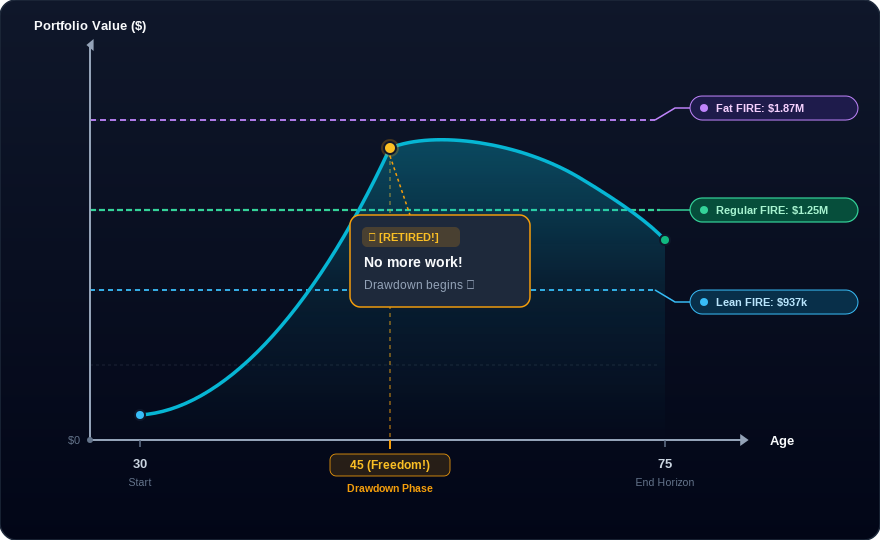
By applying the Fisher Equation (adjusting for inflation so your purchasing power remains steady decades into the future), you get to see how your portfolio holds up against everyday real-world expenses over a 30- to 40-year horizon.
If your balance holds steady or continues a gentle upward trend while funding your lifestyle, congratulations: you’ve engineered a sustainable path to independence.
If the curve dips too early, there’s no panic—the tool simply gives you honest, constructive clarity: "Consider bumping your savings rate by 5%, or letting the portfolio compound for another two years to secure the margin you need."
Planning for freedom doesn't have to be an all-or-nothing gamble. With the right math, it turns from a distant daydream into a clear, measurable roadmap.
Here is a clean, simple, and easy-to-read English guide you can use for your blog or app:
🚀 The 3-Minute Quick Guide to the FIRE Toolkit
Step 1: Plug In Your Numbers
Fill in just a few key details about your current financial baseline:
Ages: Your current age & the target age you’d love to stop working full-time.
Income & Expenses: Your annual take-home pay and your actual annual living costs (your expenses matter far more than your salary!).
Current Net Worth: Liquid/investable assets currently invested in index funds, stocks, or savings (exclude home equity).
Assumptions (Standard defaults work best):
Expected Return: 7–8%
Expected Inflation: 2.5–3%
Safe Withdrawal Rate (SWR): 4% (The standard rule of thumb for safe retirement distributions)
Step 2: Read Your Results Instantly
As soon as you enter your numbers, the model generates your personal retirement blueprint:
FIRE Target: The total portfolio size required to fund your life forever without running out of money (typically Annual Expenses × 25).
Projected FIRE Age & Years Remaining: The exact age and timeline when you will cross the finish line at your current pace.
Coast FIRE Requirement: The amount you need invested today so compound growth alone will carry you to a traditional retirement age—without saving another dime.
Step 3: Run the "Zero-Paycheck" Stress Test (Center Chart)
The most important visual is the dynamic blue curve (Projected Ending Balance):
When you reach your chosen retirement age, your paycheck drops to $0.00, and the model begins systematically withdrawing your annual living expenses each year.
Does the blue line keep rising or stay level?
👉 You're clear for takeoff! Your portfolio is self-sustaining and market returns outpace your spending.Does the line plunge toward zero after retirement?
👉 That means the portfolio runs dry too early. Tweak your levers: trim annual spending slightly, bump your savings rate by 5%, or push your retirement age back by 1–2 years until the line stays safely above water.